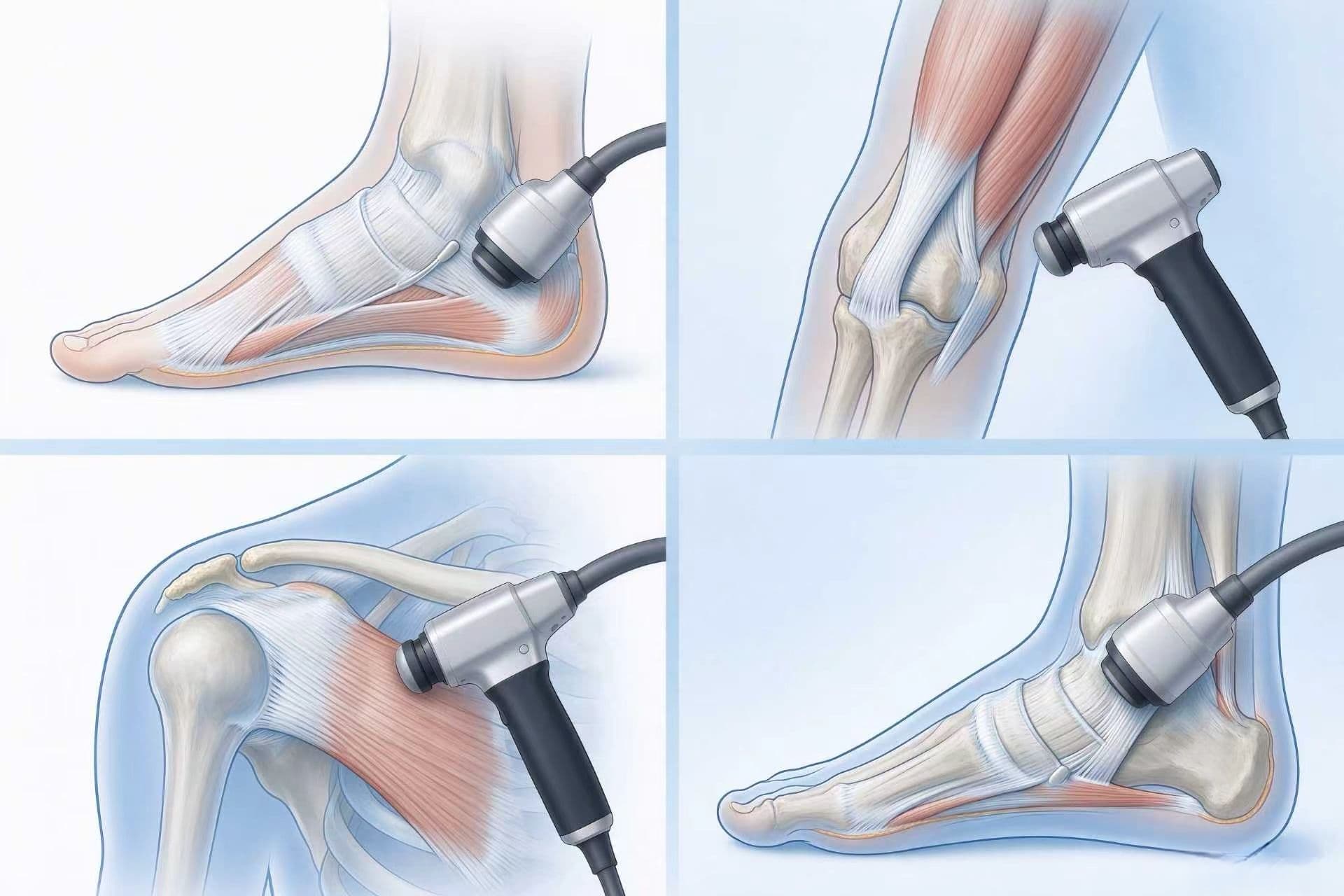
Is There a Standard Number of Shockwave Therapy Sessions?
No. ISMST guidance provides indication- and device-specific protocol examples, rather than a single session schedule for all applications. NICE guidance for refractory plantar fasciitis is explicit that extracorporeal shockwave therapy “may be applied in one or several sessions,” without specifying a fixed count.
The practical implication is that session counts must be interpreted within the indication, device type, energy level, and study protocol; no single number can be applied unchanged across all indications.
Why Session Counts Vary by Condition
The published trials show that session counts and intervals differ by target tissue. What follows is a summary of what studies delivered.

Plantar Fasciitis
A 2026 systematic review of 19 randomized controlled trials (total n = 1,738) examining radial shockwave protocols for chronic plantar fasciitis found that the most frequently used schedule was three sessions at weekly intervals, with 2,000 impulses per session at frequencies around 8–10 Hz. That was the modal protocol in the included trials, not a demonstrated optimum. The same review noted substantial heterogeneity in intensity reporting—some studies reported pressure in bar, others energy flux density—which limits direct comparison. This review was restricted to radial devices, and its findings cannot be generalized to focused ESWT systems.
NICE’s evidence review did not mandate a session count; it noted that one or several sessions may be used and that local anesthesia may influence outcomes. The 2026 review’s authors concluded that inconsistent intensity reporting is a barrier to defining a reproducible standard.
Lateral Epicondylitis
A 2026 systematic review of ESWT for chronic lateral elbow tendinopathy examined randomized trials and documented varied schedules. Most included trials described three sessions at weekly intervals—that is, one session per week for three weeks. The same review noted departures: one trial delivered shockwave daily for five days, another used two sessions per week, and a third used monthly intervals.
Importantly, this review defined radial ESWT studies as an exclusion criterion; it did not combine focused and radial evidence into a single pooled estimate. Its findings should not be used to infer session counts for radial devices, nor vice versa. No head-to-head comparison of session counts was performed within the review to establish a superior schedule.
The existence of a “most common” protocol does not mean alternatives were tested against it and found inferior. It means the literature contains a dominant pattern alongside deliberate variation.
Calcific Shoulder Tendinopathy
Published shoulder protocols vary by target, device type, energy settings, and study design. The available evidence does not establish a single optimal session count across shoulder ESWT applications, and a specific number should not be presented as a universal standard for calcific shoulder tendinopathy.
Achilles Tendinopathy and Other Conditions
For Achilles tendinopathy, the clinical evidence for benefit over sham has moved in a negative direction. A 2026 systematic review of nine randomized trials (n = 557) found no clinically meaningful benefit over sham for insertional Achilles tendinopathy (low-to-moderate certainty) and no significant differences for midportion Achilles tendinopathy at any timepoint. The authors concluded that shockwave should not be considered a routine treatment for either presentation.
The fact that a trial used three weekly sessions does not mean three sessions produce a clinical benefit that the evidence supports. Research protocols used in a trial are not, by themselves, evidence that the protocol is effective.
For patellar tendinopathy, medial epicondylitis, hip abductor tendinopathy, and fracture-healing applications, the evidence is too preliminary or device-specific to support a session-count recommendation.
How Often Are Shockwave Therapy Sessions Scheduled?
In the reviewed radial plantar-fasciitis trials, three weekly sessions were the most common pattern; in the focused lateral-elbow review, weekly sessions were also frequent, but alternatives appeared. These findings do not establish an optimal interval across all conditions. Published protocols include shorter and longer intervals.
The interval is part of the treatment protocol and must be considered alongside device type, energy settings, pulse count, and the evidence for the specific indication. A schedule used with one device class should not automatically be transferred to another.
Do Focused and Radial Treatments Use the Same Schedule?
Not necessarily. The literature does not support assuming that a schedule validated for one modality transfers to the other. The plantar-fasciitis review that identified the “three sessions, weekly, 2,000 impulses” pattern was specific to radial devices. Shoulder studies use varied protocols, and their schedules should be interpreted in the context of the individual study and device rather than treated as a single recommended course.
Session count and interval are part of a protocol, not a standalone prescription. A radial device and a focused device differ in energy deposition geometry, and the schedule that accompanies one should be verified against the device-specific Instructions for Use and the clinical evidence for that device class.
When Should a Treatment Plan Be Reassessed?
A planned number of sessions should not be treated as a commitment that must be completed regardless of response.
If there is no meaningful change in pain or function after a reasonable initial course, the appropriate next step is clinical reassessment of diagnosis, device class, energy level, and adjunctive care, rather than automatically extending the identical protocol. The better question is whether the diagnosis, device class, energy level, or adjunctive care needs to change, not whether to add more sessions of the same intervention.
If there is partial improvement, extending the course may be reasonable, but the extension should have a defined endpoint and a documented rationale. If pain worsens beyond expected post-treatment soreness, or new swelling or loss of function appears, clinical review takes priority over additional treatment.
Why More Sessions Do Not Automatically Mean Better Results
The dose–response relationship for shockwave therapy has not been established across indications. No general statement can be made that additional sessions will reliably improve outcomes or that they will reliably increase risk. Patients should not independently adjust session count, device energy, or treatment frequency without clinical oversight.
A related problem is confounding: session count is often entangled with energy level and device type. A trial that delivered five low-energy radial sessions is not evidence that five sessions of a high-energy focused protocol are appropriate, or that five sessions are better than three.
Conclusion
The number of shockwave therapy sessions needed is a protocol decision, not a fixed number that applies across all devices and diagnoses. Some indication-specific protocols use three to five sessions, but this is not a universal standard; NICE states that treatment for refractory plantar fasciitis may be delivered in one or several sessions. More sessions do not automatically produce better results, and a planned course should include a defined point for reassessment.
The practical framework is to verify the schedule against the device IFU, the clinical evidence for the specific indication, and the patient’s response—rather than treating any single session count as a standard of care.
Frequently Asked Questions
How many shockwave therapy sessions are usually recommended?
Some indication-specific protocols use three to five sessions, often spaced one to two weeks apart, but this is not a universal standard. NICE guidance for refractory plantar fasciitis states that ESWT may be applied in one or several sessions. The appropriate schedule depends on the condition, device, energy level, and clinical response.
Is one shockwave therapy session enough?
Some protocols use a series of sessions, while NICE states that ESWT for refractory plantar fasciitis may be applied in one or several sessions. Whether one session is appropriate depends on the indication, device, protocol, and clinical response; there is no universal minimum.
How far apart are shockwave sessions scheduled?
Weekly sessions were common in the reviewed radial plantar-fasciitis and focused lateral-elbow studies, but other intervals were also reported. No universal optimal interval has been established. The interval should be checked against the device IFU and the evidence for the specific indication.
Does the number of sessions depend on the condition?
Yes. The most common protocol in the reviewed radial plantar-fasciitis trials was three weekly sessions, while the focused lateral-elbow review documented several schedules. Protocol differences reflect device type, energy level, and study design; they do not establish a hierarchy of effectiveness.
What happens if symptoms do not improve after the planned sessions?
Lack of meaningful improvement after a reasonable trial should prompt clinical reassessment of the diagnosis, device class, energy level, and adjunctive care. If pain worsens beyond expected post-treatment soreness, or new swelling or functional loss appears, clinical review takes priority over additional sessions.
References
- Park H, Hwang B, Kang M-B. Radial extracorporeal shock wave therapy protocols for chronic plantar fasciitis: a systematic review of randomized controlled trials. Journal of Musculoskeletal Science and Technology. 2026;10(1):1–12. https://www.jkema.org/archive/view_article_pubreader?pid=jkema-10-1-1 View source
- National Institute for Health and Care Excellence. Extracorporeal shockwave therapy for refractory plantar fasciitis. HealthTech guidance HTG200. Published 26 August 2009. https://www.nice.org.uk/guidance/htg200 View source
- Verbeke A, Vanwalleghem E. Extracorporeal shock wave therapy in chronic lateral elbow tendinopathy: a systematic review. Orthopaedic Journal of Sports Medicine. 2026;14(4):23259671261420423. doi:10.1177/23259671261420423. https://pubmed.ncbi.nlm.nih.gov/42110492/ View source
- Korakakis V, Kotsifaki R, Sotiralis Y, Malliaras P. Shockwave therapy for midportion and insertional Achilles tendinopathy: a nail in the coffin? A systematic review with meta-analysis. Journal of Orthopaedic & Sports Physical Therapy. 2026;56(5):282–299. doi:10.2519/jospt.2026.13985. https://pubmed.ncbi.nlm.nih.gov/42063301/ View source
- International Society for Medical Shockwave Treatment (ISMST). ESWT Guidelines, English version, 3rd edition. Daegu, South Korea, July 20, 2023. https://shockwavetherapy.org/wp-content/uploads/2024/01/ISMST-Guidelines-for-ESWT-_-engl-20240103.pdf View source
This article is educational and does not replace individualized clinical assessment, current device instructions, or applicable regulatory labeling.