Why Contraindications Depend on the Device
Radial pressure waves and focused extracorporeal shockwaves deliver acoustic energy differently. A focused wave converges toward a target region; a radial pressure wave diverges from the applicator surface and loses intensity with distance. Safety guidance therefore distinguishes wave type and energy class.
A restriction for high-energy focused ESWT should not automatically be applied to every radial device, and a decision for a radial device does not clear a focused protocol. The specific IFU, regulatory labeling, and qualified clinical assessment govern.
Core Contraindications in ISMST 2023 Guidance
ISMST lists core restrictions and additional restrictions for high-energy focused ESWT. The location of the relevant structure within the actual shockwave field matters.
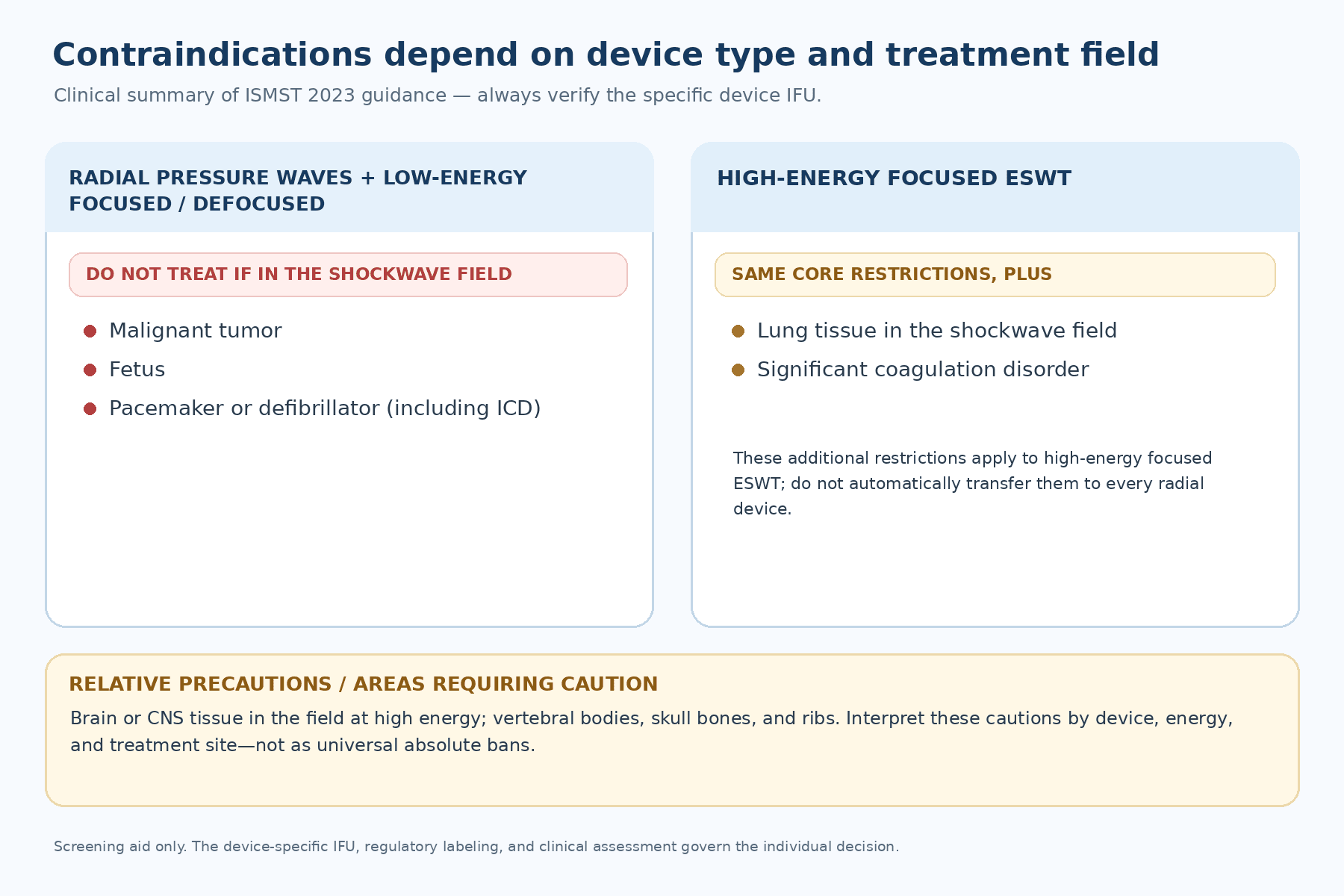
Radial Pressure Waves and Low-Energy Focused/Defocused ESWT
For radial pressure waves and low-energy focused or defocused ESWT, ISMST lists the following when they are in the shockwave field:
A malignant tumor.
A fetus.
A pacemaker or defibrillator, including an implantable cardioverter-defibrillator (ICD).
These restrictions are field-specific. A history of treated cancer is not the same as a malignant tumor in the treatment field, and the ISMST wording refers to a fetus in the field rather than pregnancy as a global status. A cardiac device outside the field is not automatic clearance; review the IFU and treatment geometry.
Additional Restrictions for High-Energy Focused ESWT
High-energy focused ESWT carries the same core restrictions, plus:
Lung tissue in the shockwave field.
A significant coagulation disorder.
ISMST also identifies relative contraindications or regions requiring caution: brain/CNS tissue in the field at high energy, vertebral bodies, skull bones, and ribs. Interpret these in the context of device type, energy, and treatment site; do not turn them into universal bans or dismiss them as routine.
Conditions Requiring Additional Clinical Assessment
Some circumstances are not consistently classified across devices and expert groups. They require documented, device-specific review rather than an assumption that treatment is prohibited or safe.
Active local infection or an open skin lesion should prompt postponement and clinical review. The 2025 Delphi panel reported varying classifications for local infection, so it should not be described as a universal absolute contraindication. Follow the IFU and service protocol.
A major nerve in or near the field calls for anatomical assessment; the 2025 Delphi panel did not reach uniform agreement on its classification. Adjusting energy or targeting alone does not establish safety, and an alternative may be appropriate.
Open epiphyseal plates in growing patients require device-specific review. Guidance is not fully aligned, and a guideline’s silence does not prove safety; the IFU and assessment of the target anatomy should guide the decision.
A recent local corticosteroid injection is a timing question, not a permanent exclusion. The 2025 Delphi study did not establish a universal interval after local injection or systemic steroids. Check the IFU and obtain the treating clinician’s judgment.
Pregnancy, Cancer, and Cardiac Devices: Why Location Matters
ISMST ties its core restrictions to the shockwave field; this does not mean treatment outside the field is automatically safe.
Pregnancy: ISMST specifies a fetus in the shockwave field. The 2025 Delphi panel showed divided opinion on distant-site treatment. A remote target should not be described as automatically safe; assess and document the proposed field, IFU, and individual circumstances.
Cancer: the core restriction concerns a malignant tumor in the treatment field, not simply a history of cancer. The 2025 Delphi panel reached consensus that active malignancy near the treatment area is an absolute contraindication for radial pressure wave therapy and focused ESWT; classifications for active malignancy away from the area were less consistent.
Pacemakers and ICDs: ISMST 2023 lists a cardiac device in the shockwave field as a “do not treat” condition for radial, low-energy focused/defocused, and high-energy focused ESWT. A device outside the field still requires IFU review and documented assessment of the intended treatment geometry.
What Clinicians Should Check Before Treatment
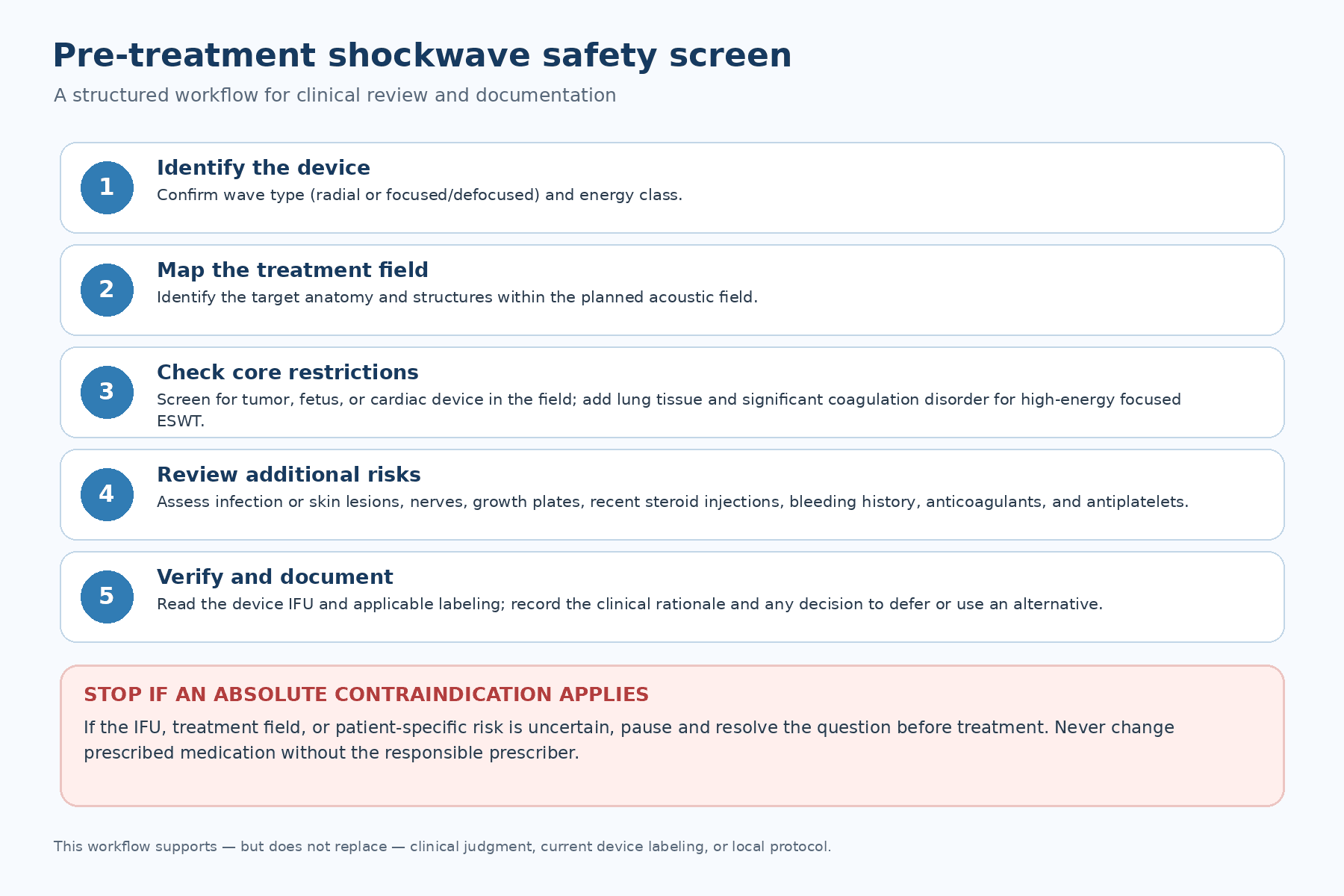
A structured screen is more reliable than a memorized diagnosis list. Before treatment, the team should:
For an overview of focused, defocused, and radial terminology, see “What Is Shockwave Therapy?”
Ask directly about pregnancy, active or previous cancer, implanted cardiac devices, bleeding history, medication use, local infection or skin lesions, growth-plate status where relevant, and recent corticosteroid injections.
Confirm the device type and energy class. Identify whether the device delivers radial pressure waves or focused/defocused shockwaves, and verify the planned energy level.
Map the actual treatment field. Compare the target and acoustic field with the ISMST restrictions, including malignant tumor, fetus, or cardiac device in the field; for high-energy focused ESWT, also check for lung tissue and significant coagulation disorder.
Review the patient’s history and medication list. Distinguish diagnosed coagulopathy from anticoagulants and antiplatelets, and review infection or skin lesions, major nerves, growth plates, and recent corticosteroid injection.
Read the device-specific IFU and applicable regulatory labeling. Society guidance is not a substitute for the labeling and instructions governing the specific platform.
Document the decision. Record the relevant anatomy, device and energy class, contraindication screen, clinician rationale, and any decision to defer or use an alternative approach.
If an absolute contraindication in the IFU applies, do not proceed. If the field, labeling, or patient-specific risk is uncertain, pause until resolved.
Absolute Contraindications vs. Relative Precautions
An absolute contraindication for a specific device and field means treatment should not be performed under those circumstances. A relative precaution requires risk assessment and may call for modification or an alternative. A condition requiring device-specific assessment cannot be classified by name alone.
The 2025 Delphi consensus documents both agreement and unresolved classifications. It can inform clinical reasoning but does not override the device IFU or regulatory labeling. Uncertainty is a reason to pause, verify, and document—not to assume safety.
The Delphi study involved 41 experts from 13 countries and reached consensus on 69 of 118 statements overall; not every contraindication item reached consensus. It is expert guidance, not proof that a disputed condition is safe or unsafe in every clinical context.
Conclusion
There is no single answer to “who should not receive shockwave therapy” across every device and site. ISMST 2023 provides tiered restrictions for radial pressure waves, low-energy focused/defocused ESWT, and high-energy focused ESWT. Infection, nerve proximity, open growth plates, recent steroid injection, and medication-related bleeding risk require device-specific assessment rather than categorical assumptions.
For an individual patient, the device-specific IFU and applicable regulatory labeling must be considered alongside the proposed treatment field, clinical assessment, and documented reasoning. This article is educational information and is not a substitute for professional medical judgment or the current instructions for the device being used.”
Frequently Asked Questions
Who should avoid shockwave therapy?
Under ISMST 2023, treatment should not be performed when a malignant tumor, fetus, or pacemaker/defibrillator is in the shockwave field. High-energy focused ESWT adds restrictions for lung tissue in the field and significant coagulation disorders. Other circumstances require review against the device type, energy, target anatomy, and IFU.
Is shockwave therapy safe during pregnancy?
It should not be performed when a fetus lies in the shockwave field under the ISMST framework. Treatment at a distant site is not automatically safe; expert opinion is divided, and the clinician must assess the proposed field, device instructions, and individual circumstances.
Can patients with pacemakers receive shockwave therapy?
A pacemaker or defibrillator in the shockwave field is a do-not-treat condition in ISMST 2023. If the device is outside the field, treatment still requires review of the specific IFU and a documented assessment of the proposed treatment geometry; it is not automatic clearance.
Can people taking blood thinners receive shockwave therapy?
It depends on the medication, bleeding risk, treatment site, device, and IFU. A significant coagulation disorder is an additional restriction for high-energy focused ESWT, but anticoagulant and antiplatelet medicines are separate clinical considerations. Patients should never change prescribed medication without the prescribing clinician.
References
- 1. International Society for Medical Shockwave Treatment (ISMST). ESWT Guidelines. English version, 3rd edition. Updated and agreed July 20, 2023. Chapter 3: Contraindications and adverse effects of ESWT, pp. 20–21. https://shockwavetherapy.org/wp-content/uploads/2024/01/ISMST-Guidelines-for-ESWT-_-engl-20240103.pdf View source
- 2. Rhim HC, Singh M, Maffulli N, et al. Recommendations for use of extracorporeal shockwave therapy in sports medicine: an international modified Delphi study. British Journal of Sports Medicine. 2025;59(18):1287–1301. doi:10.1136/bjsports-2024-109082. https://bjsm.bmj.com/content/59/18/1287 View source
- 3. Moser H, Lindner D. Fachgerechte Durchführung von Stoßwellentherapie (SWT/ESWT) im Rahmen der Berufsausübung als Physiotherapeut*in. Physio Austria; version July 2025. See the contraindication summary on printed p. 7. This document summarizes DIGEST 2024 guidance; it is not a standalone DIGEST 2024 publication. https://www.physioaustria.at/sites/default/files/2025-08/Fachinformation%20Sto%C3%9Fwelle_v3_0724_final.pdf View source
This article is educational and does not replace individualized clinical assessment, current device instructions, or applicable regulatory labeling.